Atlas of the known world
The Titanlord atlas
Titanlord is a completed dark epic fantasy saga in four volumes by M.G. Darwish, published between 2018 and 2023. It is a series of novels. The official prequel game is The Black Sword: Legends of Red.
The map was drawn once, in September 2020. The books kept writing. Thirty eight places are named in the saga; eight of them argue with the map, and both readings are kept. This atlas is safe for a reader who has finished Of Death & Sacrifice.
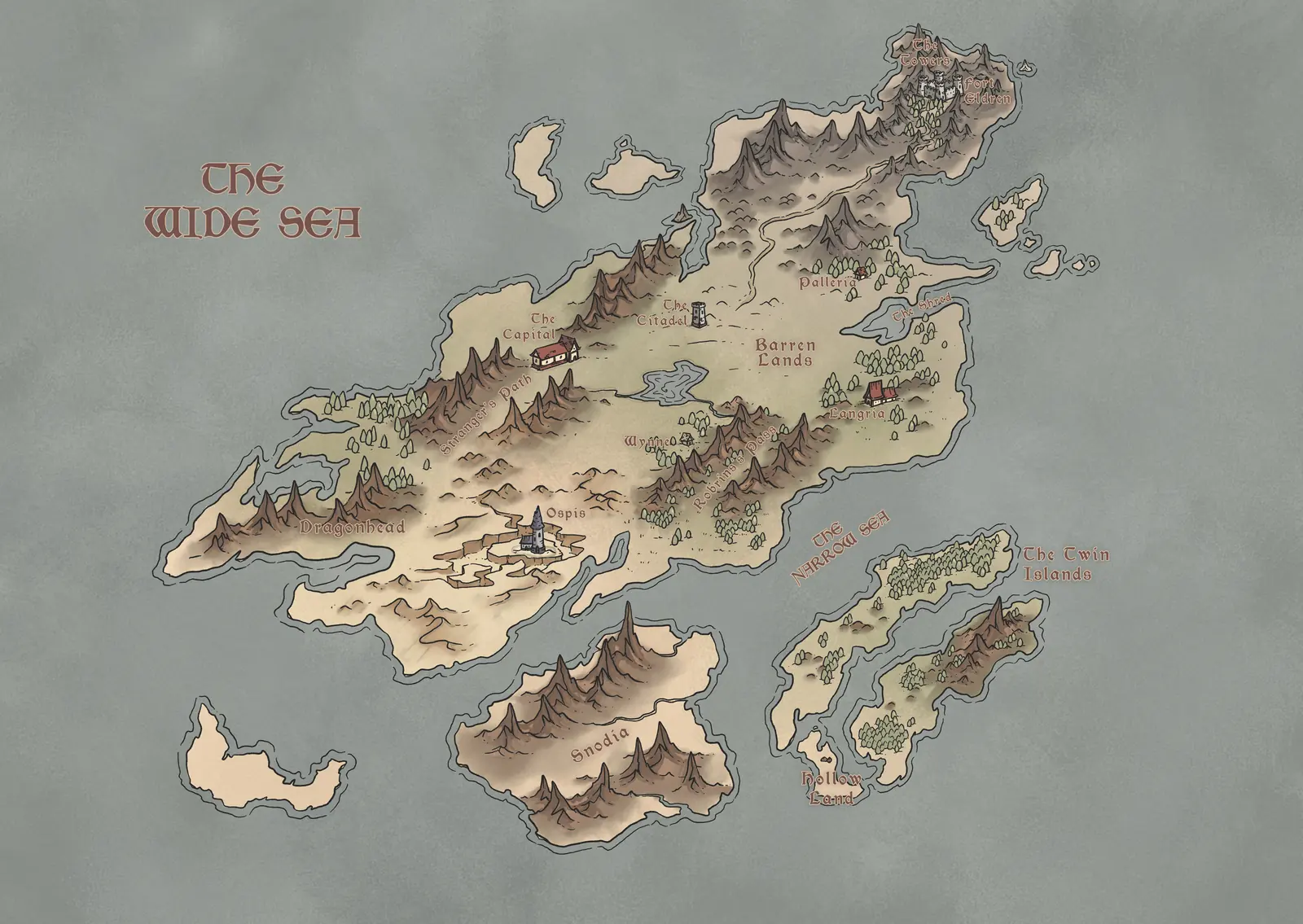
Every place, in writing
The locations, one by one.
-
Palleria Contested
A peace loving village that gave the world many of its heroes and wrote the history books the rest of the world reads. It keeps a store of ancient lore, a bell heard in every corner, a school, barracks, and tunnels its best warriors dug for moving food in wartime. Its bravery was read at court as a threat, yet it stayed loyal.
Where the saga opens, and the home Vendel and Griffyn are forced to leave.
-
The Citadel
The Mainland's great walled city, shut behind a hardened steel gate lined with crossbowmen, with a tower at its centre visible from every corner. Inside: a market district with a slave square, a granary, a vault, a graveyard, an execution platform and a well. A tunnel beside the barracks runs out of the city, kept secret for sieges.
The first great city the story reaches, and the prize every army in the saga wants.
-
The Capital
The seat of the Crown, a city on a hill behind a giant steel gate and hardened steel walls, its districts divided by marble pillars, its castle set behind a moat. A long red carpeted corridor runs to a court large enough to hold a small army, with the throne at its end. Legend says no arrow has touched its walls in hundreds of years.
Where the Magmar dynasty has ruled for millennia, and where Book 1 is heading from its first page.
-
Wynne Contested
A village with ambitions of becoming a city, ringed by a stone wall about ten feet high. Shops, inns and taverns line one side of its central path, houses the other, and the Mayor's keep stands at the end of it. It holds a Traders Union that polices fraud, and the Teetan temple of Domum.
A small place the whole war turns on, and the location the books argue hardest about.
-
Fort Eldren Contested
A fortress so well hidden that travellers find it only by crosses carved on tree trunks, set atop a mountain with one narrow path in and deep water all around. Its corridor smells of old pine, rust and vanilla and carries eight bolted paintings, four to a side. Mines run beneath it, and something far older than the fort lies at their end.
The Red Hand's stronghold, and the single most argued over place in the atlas.
-
Robrin's Pass Contested
A wooded crossroads of tall trees, bushes and clearings, with mountain chains close by. One road leads back to the Citadel, one to Wynne and one to the Capital, and Book 3 adds a fourth arm to Langria. Armies camp here in every volume. It is named for Robrin the Red Knight, who charged a Titan's army here and won.
The strategic hinge of the Mainland: almost every land campaign passes through it.
-
The Towers
The furthest northern point on the Mainland and its tallest mountains, said to oversee the whole continent. Abandoned forts stand among them. Legend holds that the highest peak touches the whisks of the heavens, which the soldier who repeats it calls just a legend. From up there, folklore says a sharp eye may catch the Twin Islands far to the south, a claim nothing else in the books supports.
The Mainland's northern wall, and the anchor the books use to place Fort Eldren.
-
Dragonhead
A dead land on the south-western peninsula, cursed by the Creator himself, where nothing grows and the air is poison to anything human. Scorched earth, a foul stench, leafless withered trees. Rabid Titans without thought or reason range across it. Children on every coast are raised on the same warning: never step into Dragonhead.
The frontier the prequel walks into, and the oldest wound in the world.
-
The Barren Lands
Dead ground between the Citadel and Langria that the books never once describe. Everything known about it is reputation: dark souls stalk it, and a pack of Dwellers will eat your brains out. It is said to be the fastest road to the Citadel, and nobody takes it. Even the crossing Book 1 promises is never narrated.
The saga's great blank space: named, feared, and never once shown on the page.
-
Langria
A city that was once a popular destination and now stands close to empty, its gates left open so people may leave. The keep is rigid and looks ready to fall. Granaries, a town square and an inn remain, and one building is still lit: a tavern called Weeping Angels, which also keeps a fortune teller.
House Blackborn's seat, held to ransom by the bandits who drink in its one lit tavern.
-
Ospis, the City of Thieves
The City of Thieves, hidden deep in the mountains overlooking Robrin's Pass and guarded by a maze of sand. It sits on a hill ringed by a deep trench, and many argue the structure is far too advanced to be a cause of nature. It has no barracks: everyone who fights for Ospis lives in it, and recruits give up every rank and title at the wall.
A city the Crown refuses to recognise, run by a council of whoever outlasted everyone else.
-
Hollow Land
A parched, lifeless island that smells foul, the opposite of the green islands beside it. The people nearest it call it cursed and say nothing grows there. No official route exists, and no one will sail you across. One account calls it a Titan's grief made permanent; another calls it a piece of a broken island.
The most forbidden place in the saga, and the one every road avoids.
-
The Twin Islands Contested
Two long islands in the south-east, lush and green, with trees tall enough to keep the sun off the ground, almost as if the Creator blessed them. Their villages are small clusters of mud houses built around boulders, with wells, shops and a militia, rebuilt again and again after bandit raids. A bandit fortress holds one of them.
Legend says these and Hollow Land were one island once, split by a single blow.
-
Snodia Contested
The world's other major landmass, dusty and humid, and technically one giant beach. Its northern region is marked by tall mountains said to rival the Towers, and a white mountain serves as its landmark. The town of Brekk sits at the edge of a mountain slope. Bandits plague it, and the Crown's protection never arrives.
Home to several of the saga's soldiers and knights, and the only place the books call a separate country.
-
Stranger's Path Contested
A mountain route drawn and labelled on the official map, running through the western mountains below the Capital. It appears nowhere in the four manuscripts. No character walks it, nobody mentions it, and nothing in the prose says what it is. It exists on the cartography and in no other place.
The map's own contribution to the canon, and the clearest case of the cartography running ahead of the books.
Not on the published map
Three places the books name but the cartographer never labelled. Recorded here because the atlas hides nothing.
-
Lake Vita
A wide lake of mystic water with a salty ocean scent, lush grass at its edges and one tall tree that has stood there against all strands of time. The path to it is narrow dirt, never built for armies. Travellers keep away: bandits roam it, and no king could ever secure the road.
A few days from the Citadel, sitting on two separate marching routes, and on no version of the map.
-
Arkala
An island that was once lush and thriving and has fallen into ruin, tall vines and leaves covering what used to be a bustling port. Tents burn with candlelight. A narrow path climbs to a cave whose mouth glows, and the far dark end of the island, near the sound of the waves, is called the Deep.
An all female society under a priestess, on an island the books place only by saying it overlooks the Capital.
-
Myrn, the island Contested
An island just south-east of the Mainland, called a land of dreams, its wind carrying dust from one end to the other. Its docks look out over the Shred, its hills carry a voice that will not stop, and its villages thrive on trade. Titans have kept away from it since the day of creation.
Where the prequel ends. One account said the tools of Armageddon would be forged there, another that it housed the Throne of the Creator.
Lettering note: Robrin’s Pass is lettered on the map as Robrunn’s Pass. The map also omits Myrn, Lake Vita, Arkala, Brekk and Delmoria, and draws several islets it never names. Where map and prose disagree, this atlas keeps both readings and settles neither.
Who holds what
The powers of the known world.
-
The Crown, the Empire
The empire that has held the Mainland for millennia from the Capital, with the Imperials as its glorified guards, a Royal Army in numbered battalions and a spymaster in every lord's hall. Its reigning king grants village expansion papers by hand, to keep villages from aspiring to become cities.
Led by King Magmar the Thirteenth · Seat: The Capital
-
House Magmar
The dynasty that has sat the throne at the Capital for millennia, founded by King Magmar the First, who legend says raised an army against the seven Titans and took two of their powers. The house sigil is never described in the books. Princess Luna wears an eagle embroidered in gold on her right shoulder.
Led by King Magmar the Thirteenth, last of the line to reign · Seat: The Capital
-
The Red Hand's army, the army of light
The rebel army that rose against the Crown, was crushed, and survived underground. Its words are Of the light, by the light, spoken by soldiers who know they are walking to their deaths, and used as a challenge between friends. Its law is justice above all, its doctrine never to proceed without caution.
Led by Benjen Daguth, the Red Hand, called the Commander of Light · Seat: No fixed seat
-
The Royal Army
The Crown's regular force, organised in numbered battalions of about five hundred men each. It marches under the flags of the King and fights crying for the glory of King Magmar. No device of its own is ever described. The Third Battalion is the one Book 1 follows most closely.
Led by The Crown; Captain Wilson Harlet leads the last rallied regiment · Seat: The Capital
-
The Militia of Palleria and the First Sword
Palleria's own fighting body, commanded by the First Sword, the finest swordsman in the village, who trains every newcomer. By tradition anyone turning sixteen may be trained and join. The Elder governs. Most of the generals who matter later in the war came out of this one village.
Led by The Elder of Palleria, with the First Sword commanding the Militia. Roriana Macintyre holds the title. · Seat: Palleria
-
The Colored Knights
An order so rare that only six have existed in the whole history of the world. They stand above all others in combat and bravery, the books say, because they do not fear death but welcome it. Robrin the Red Knight and Aizeya the Black Knight are named among them, and the roll is never completed.
Led by None stated; the Crown promotes them, and seldom · Seat: Unspecified
-
The Teetans
A faith that worships the Titans as the gods of old, in brown robes with a band across the brow. Their chant is Veda, Pollus, Magnus: the Voice, the Strength and the Dream. They follow the ancient laws, trial by combat among them, and they alone can still read fragments of the ancient tongue.
Led by Local priests; the Priest of the Domum temple in Wynne is the only one shown · Seat: The Domum temple, Wynne
-
The Titans, the Old Children
Made by the Creator, each with one power meant to help humanity fight its own greed, and one of them crowned above the rest. The Teetans call them Ranulak. Every Titan swore an oath not to harm another, amid gods and kings alike. The books' own histories cannot agree on how many there ever were.
Led by Veda the Voice, King of the Titans · Seat: No single seat
-
The Gods, the New Children
Another branch from the Divine, made long after the Titans to balance them and keep them in check. Twelve in number. They are brothers and call the Creator Father. They sit in council on thrones encrusted with gold in a room with no candles that is lit anyway, and they are bound by their own oaths.
Led by Nepherin, King of the Gods · Seat: Their council chamber, a lit room of gold encrusted thrones
-
The Dwellers
Dark, corrupted things that come up out of the underground and fight in overwhelming numbers, with no fear of death and a gaze that enslaves. Stories say they were human once, zealots who swore to defend all life. By the second book they bring siege engines, battering rams and protected flanks.
Led by Unspecified in Book 1; a golden armoured commander leads them in Book 2 · Seat: The underground
-
House Blackborn of Langria
The lords of Langria, father and daughter, holding a keep that looks ready to fall in a city its people have been leaving. Derrick Blackborn's creed is that a man can only acknowledge when he is mistaken and hope to make amends for what follows. His heir Robyn is an archer and a smuggler.
Led by Lord Derrick Blackborn · Seat: Blackborn's keep, Langria
-
The House of the Double Etched Swords
Lord Quinn's house, loyal to the Crown for generations until his father broke his oath and took up arms against his liege. Quinn beat his father in single combat and took the house himself. He wears its mark on ice coloured armour and swears by it: the double etched swords are what will witness this day.
Led by Lord Quinn · Seat: Unspecified
The frame of it
The regions and the seas.
The Known World
One continent called the Mainland, a scatter of islands around it, and at least one other landmass, Snodia, which the books call both a separate country and another continent. The world is never drawn whole in the prose, only in pieces. Its calendar counts from a descent: the prequel dates itself 3299 B.D., before descent, and the mechanism is named exactly once, when a Titan speaks of a seal breaking, the Gods descending and Dwellers coming to stalk the lands. What the seal held, who set it and what broke it are never stated.
The Mainland
The saga's principal theatre, and the continent nearly every campaign is fought on. It is named constantly and bounded nowhere. Its northern limit is fixed at the Towers, the furthest northern point on the Mainland; to the south, beyond the water called the Shred, lie the Twin Islands and Hollow Land. It holds the Capital, the Citadel, Palleria, Wynne, Langria, Robrin's Pass, Lake Vita, Ospis, the Barren Lands and, by Book 2's account, Fort Eldren. Terrain runs from forest and plain to mountain chains at the Towers and around Ospis and Fort Eldren, scorched ground at Dragonhead in the south-west, and dead ground at the Barren Lands. The commissioned map is drawn north up, which sets the continent's long axis running north-east to south-west.
The southern islands
All the way south, beyond the Shred, lie the Twin Islands and Hollow Land. The Narrow Sea runs between them, and the elder of a Twin Islands village says there is no real way to cross it. Legend holds the two were once one big island, and Book 2 puts the split down to Brelleck, an ancient Titan who separated them with his fist. The Twin Islands are green and blessed; Hollow Land is parched and shunned.
Snodia
The world's other major landmass, directly south of the Capital, and not reachable directly by boat. Its northern region is tall mountains said to rival those at the Towers, and a white mountain is its landmark. One officer calls it a separate country that is a bit far from here; a general calls it another continent. A recruit introduces himself as hailing from Snodia, north of the white mountain. The map simply draws it as a large mountainous island in open water.
Arkala and the unplaced places
Arkala is placed only by function: an island that overlooks the Capital, used as a staging point for a fleet. No line in the four books gives it a compass bearing, and the map does not label it. The same is true of Lake Vita on the Mainland, Brekk on Snodia and Delmoria on Myrn, all named in the prose and absent from the cartography. Where the books never place something, the wiki records the gap rather than filling it.
The seas
Three waters carry names. The Shred is never described: it is the water the docks of Myrn overlooked, the boundary beyond which the southern islands lie, and a position of stated strategic value. The Wide Sea guards Fort Eldren's rear and holds the smugglers' coast east of the Capital, with a rustic tavern, a fighting circle and cave mouths hiding ships; it also stands as an unexplained part heading before the prologue of both Book 2 and Book 3. The Narrow Sea is the water the books put between the Twin Islands and Hollow Land, and the map draws between the Mainland and the Twin Islands.
Realms that are not places
Two realms sit outside the geography. The dream realm of Magnus is an endless trail of clouds where the air feels fresher than the waking world, ruled by the Titan of Dreams and entered through sleep. The underground is where the Dwellers come from, reached in practice through the mines below Fort Eldren, and never described beyond that. A third, the True Void, is Book 3 material and should stay behind a spoiler gate.